
Techno-Economic Analysis (TEA) & Life Cycle Assessment (LCA)
REI provides Techno-Economic Analysis (TEA) and Life Cycle Assessment (LCA) to support technology development, scale-up, and commercialization decisions for energy-intensive and industrial processes. Our work focuses on early-stage and first-of-a-kind technologies, where understanding cost, risk, and environmental impact is critical.
Techno-Economic Analysis (TEA)
REI’s Techno-Economic Analysis translates technical performance into clear economic insight. Our TEA studies are grounded in detailed process and reactor modeling, enabling defensible assumptions and realistic scale-up projections.
Capabilities include:
Process- and system-level mass and energy balance development
Bottom-up CAPEX and OPEX estimation for early-commercial systems
Sensitivity and scenario analysis to identify key cost drivers and performance thresholds
Scale-up assessments linking laboratory, pilot, and commercial performance
TEA results are used to compare technology pathways, define meaningful performance targets, and inform R&D and investment decisions.
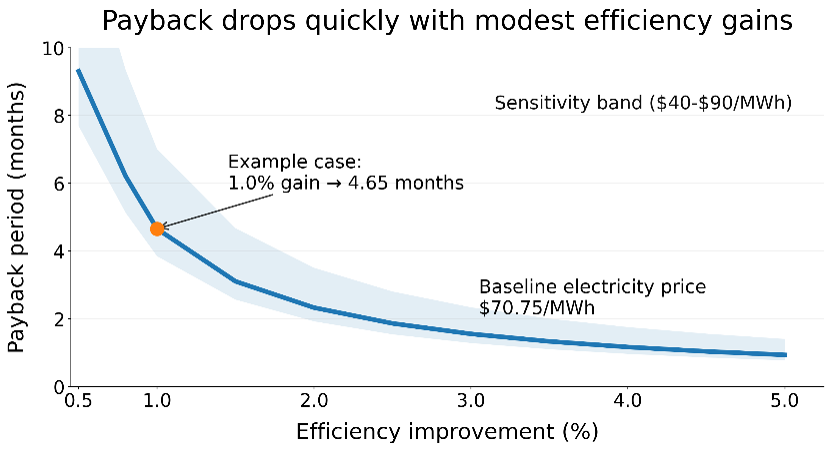
Payback vs. Efficiency Gains
Life Cycle Assessment (LCA)
REI conducts Life Cycle Assessments to quantify environmental impacts, with a primary focus on “cradle-to-gate” system boundaries appropriate for early-stage technology development.
Capabilities include:
Cradle-to-gate LCA modeling from raw materials through process output
ISO 14040/14044-aligned methodology
Greenhouse gas emissions accounting for emerging and decarbonization pathways
Identification of dominant emissions drivers and environmental hot spots
Comparative evaluation of alternative process configurations
LCA results are used to identify high-leverage decarbonization opportunities and guide technology design decisions.
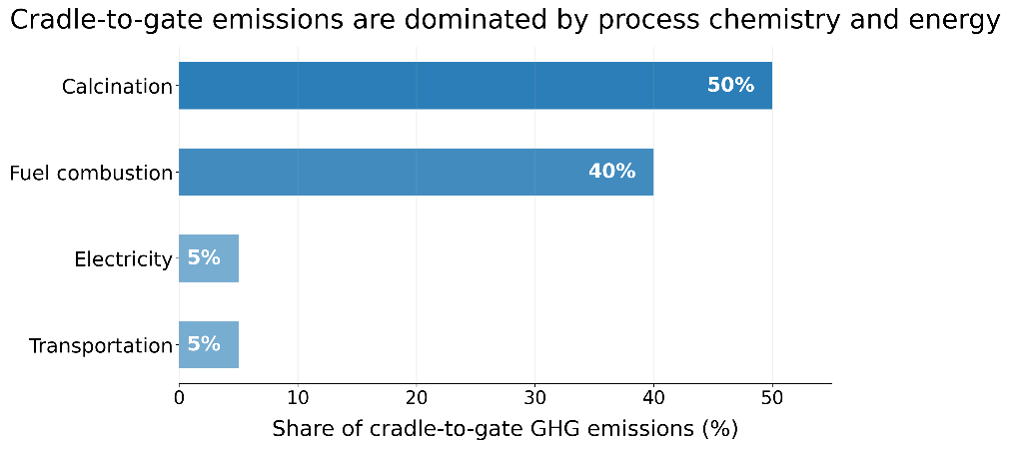
Cradle-to-gate Emissions
Integrated TEA + LCA
REI integrates TEA and LCA to evaluate both economic and environmental performance within a consistent framework.
This integrated approach enables:
Identification of tradeoffs between cost, efficiency, and emissions
Comparison of technology pathways under consistent assumptions
Development of metrics such as carbon abatement cost ($/tonne CO₂ avoided)
By linking process-level modeling, economics, and cradle-to-gate environmental analysis, REI helps clients move from technical concept to informed deployment strategy.